Experiment
EXP 02: Multiple Hindcast Testbed
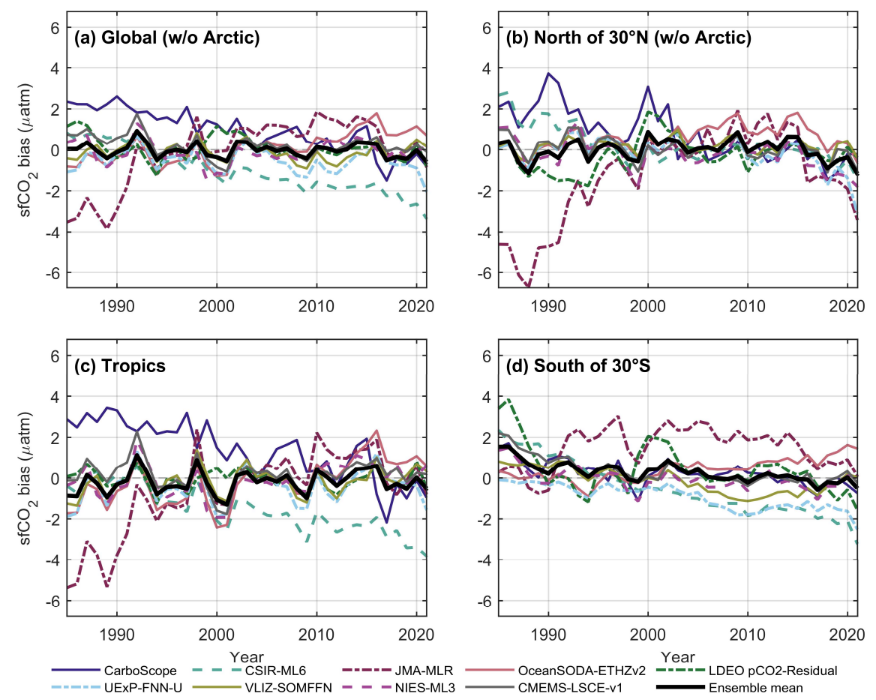
‘Assess how sfCO₂ reconstruction biases (mean state and trend) vary across methods and GOBM testbeds and whether method-specific biases persist or are partially compensated within the multi-method ensemble.
Overview
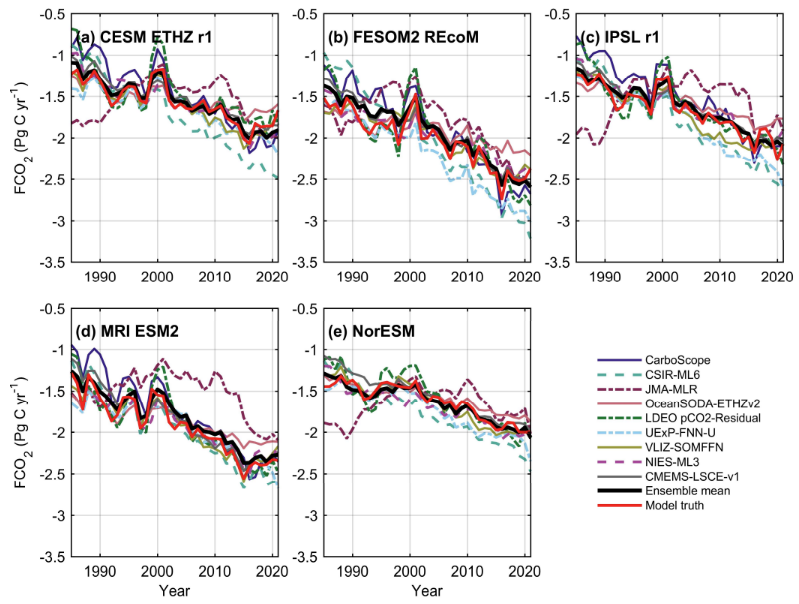
sfCO₂ reconstruction methods are trained on sparse sfCO₂ observations, so their skill in unsampled regions cannot be tested against the real ocean. This experiment uses GOBMs as a known model truth to assess how well each sfCO₂ reconstruction method reproduces sfCO₂, FCO₂ and the ocean carbon sink.
Lead Author
Manuscript
Alizée Roobaert, Daniel J. Ford, Mohanan G. Sreeush, et al. Reconciling ocean carbon uptake estimates: a multi-model assessment of surface ocean CO₂ reconstruction skill within the SOCOMv2 initiative. ESS Open Archive, 20 May 2026.
Experiment Information
| Status: | In review |
| DOI: | 10.22541/essoar.15003624/v1 |
| Testbed: |
5 GOBMs:
1 GCB 2024 version, identical to GCB 2023 except that sfCO₂ is referenced to moist air instead of dry air, as required for a consistent recalculation of FCO₂. |
| sfCO₂ reconstruction methods: |
9 sfCO₂ reconstruction methods:
3 Used instead of LDEO-HPD, the version used for the GCB (Gloege et al., 2022). LDEO-HPD relies on GOBM priors, which would introduce the model truth into the sfCO₂ reconstruction. LDEO pCO2-Residual uses a similar eXtreme Gradient Boosting regression and achieves comparable validation performance. |
| SOCAT mask used: | SOCATv2023 |
| Design: | EXP 02 uses a multi-model testbed to evaluate nine sfCO₂ reconstruction methods under sparse observational constraints and assess how sfCO₂ reconstruction biases propagate into FCO₂. Monthly sfCO₂ fields from five GOBMs are sampled according to monthly gridded 1° x 1° SOCATv2023, reconstructed, and compared with complete model fields. A harmonized FCO₂ protocol isolates differences arising from reconstructed sfCO₂. |
Skill of 9 sfCO₂ reconstruction methods across 5 GOBMs