EXP 06: Observing Design
Evaluates how enhanced in situ sfCO₂ sampling beyond the current observing network impacts sfCO₂ reconstruction skill and the accuracy of ocean carbon sink estimates.
Overview
Reconstructions of full field sfCO₂ rely on ship-based observations from SOCAT, which are sparse in space and time.
EXP 06 evaluates how enhanced in situ sampling affects sfCO₂ reconstruction skill and the accuracy of ocean carbon sink estimates, and quantifies the resulting uncertainty reductions.
The experiment focuses on sampling that can realistically be added to the existing observational network with minimal cost, including research and commercial vessels that currently frequent the Southern Ocean, discontinued platforms, and Uncrewed Surface Vehicles (USVs).
With these enhanced observational data sets, sfCO₂ is reconstructed globally using seven reconstruction methods, and FCO₂ is calculated using the sfCO₂ reconstructions.
Reconstruction skill is assessed by applying a testbed approach (three GOBMs) and evaluating the reconstructed sfCO₂ and calculated FCO₂ against the testbed truth.
With only modest, but potentially immediately feasible, enhanced in situ sampling beyond the existing sampling network, what is the expected uncertainty reduction in sfCO₂ reconstructions, and subsequently, the global ocean carbon sink estimate?
Lead Author
Manuscript
In preparation
Experiment Information
| Status: | In preparation |
| DOI: | To be added |
| Testbed: |
3 GOBMs:
|
| sfCO₂ reconstruction methods: |
7 sfCO₂ reconstruction methods:
|
| SOCAT mask used: | SOCATv2025 (Bakker et al., 2025) |
| Time period: | 1983–2024 |
| Design: |
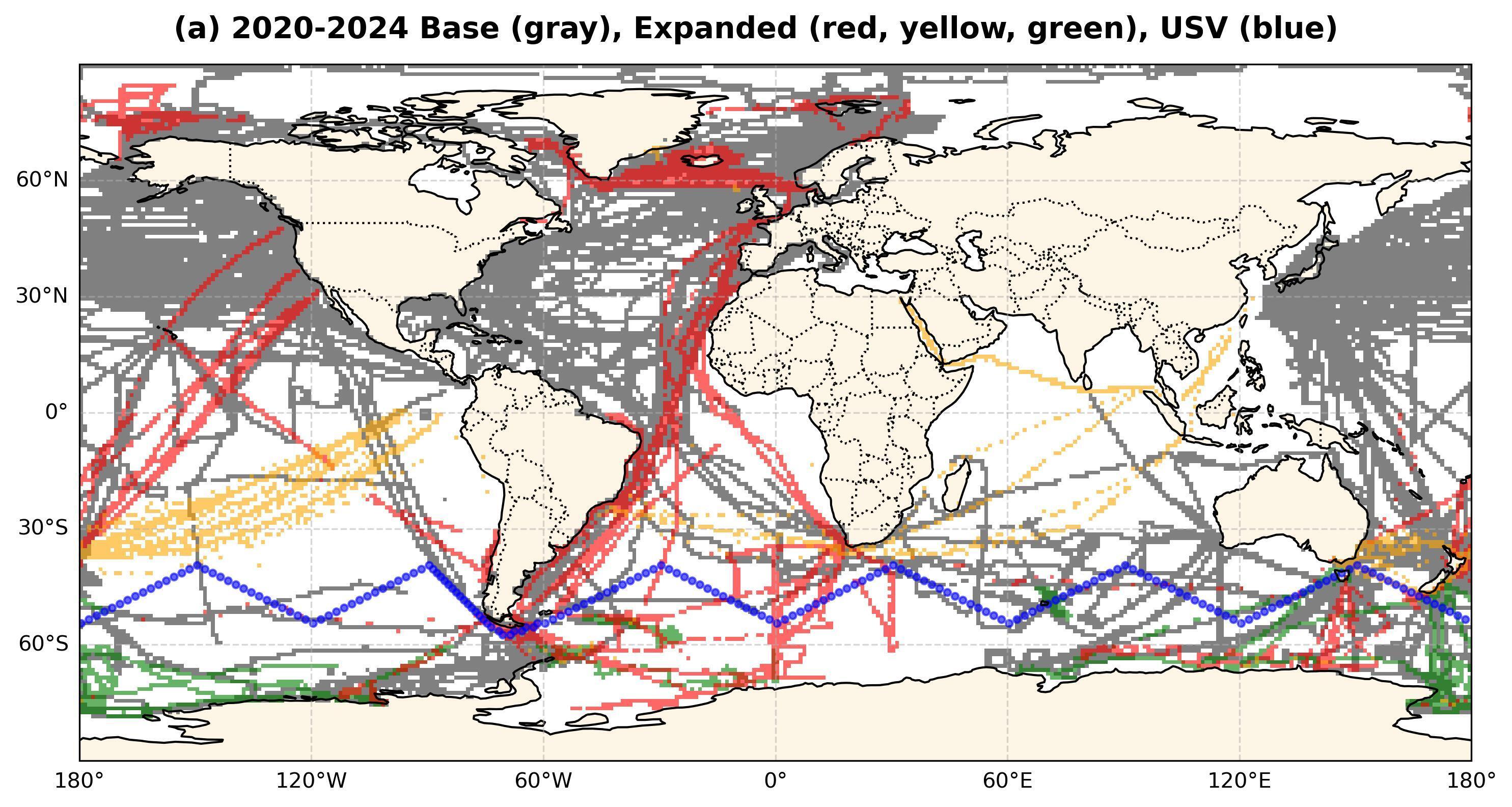
EXP 06 uses a total of seven sampling masks. The basis for all seven masks is monthly 1°×1° gridded SOCAT data (version 2025; Bakker et al., 2025) for 1983–2024 (‘BASE’; Figure, gray). For each of the six enhanced sampling masks, the ‘BASE’ mask is augmented with ship or USV locations for the years 2020–2024. For the enhancements, the impact of pragmatic, achievable additions to the observing system is emphasized, as opposed to an ideal network design. These include ships that do not currently observe sfCO₂ but could help address gaps in sfCO₂ observations in the Southern Hemisphere and the high-latitude Northern Hemisphere with relatively low effort.
Tracks are compiled from (1) Voluntary Observing Ship (‘VOS’) lines that already provide other oceanographic data (Figure, yellow), (2) five research vessels (‘RV’), one cruise liner and one fishing vessel that frequent the Southern Ocean and could be outfitted with carbon monitoring equipment (Figure, green), and (3) discontinued (‘DISC’) tracks that had previously contributed data to SOCAT (Figure, red). In addition, one mask includes the locations of all three classes of ship (‘ALL’). A further mask is based on planned sampling in the Southern Ocean by USVs (Heimdal et al., 2024) for the COCO2 project, where high-quality fCO₂ observations will be collected on four circumnavigations of Antarctica each austral winter (May–October) in 2026–2030 (Figure, blue). USV locations are combined with the ‘BASE’ (mask named ‘USV’) and the ‘BASE+ALL’ locations (mask named ‘USV+ALL’) for two additional experimental sampling masks. Using a testbed of three GOBMs, sfCO₂ is reconstructed globally over the period 1983–2024 using seven reconstruction methods. Due to computational limitations for some reconstruction methods, only four performed all sampling experiments. All seven methods performed the ‘BASE’ and ‘ALL’ experiments. |